Kya Clark Is Acquitted
Where the Crawdads SingKya Clark’s acquittal turns a murder trial into a sudden release from confinement, but not a simple reconciliation with Barkley Cove. The jury finds her not guilty of Chase Andrews’s first-degree murder; she is free to leave after two months in jail. Around that legal decision, the courtroom’s held breath, the town’s divided response, and Kya’s return to her marsh home give the verdict a wider meaning: it ends the case against her without making her feel at home among the people who watched it.
The verdict in the courtroom
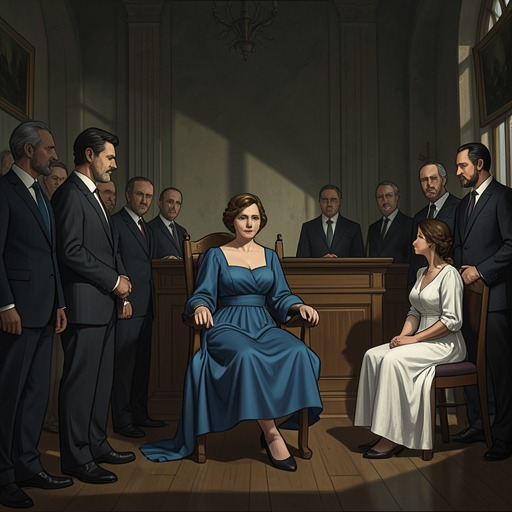
At four o’clock, Tom Milton opens the door and announces that the jurors have reached a verdict. Tate Walker is startled by how quickly the moment has come; Jodie Clark urges him to go back inside. The jurors file into the box in a silence so complete that the gallery makes no cough or shuffle. Sally Culpepper glances toward Kya, while the other jurors keep their eyes ahead. The stillness makes the wait feel communal: the room seems to be awaiting judgment alongside the defendant.
Harold Sims takes the bench and confirms that the jury has reached its decision. Mr. Tomlinson, the foreman and owner of the Buster Brown Shoe Shop, answers for the panel. At the defense table, Tom Milton touches Kya’s arm and helps her stand; Tate grips the railing as close to her as he can get. Jumpin’ holds Mabel’s hand. The shrimper Hal Miller, meanwhile, wrestles with his uncertainty about whether he truly saw Kya’s boat that night. His doubt captures the pressure of the moment: a witness’s memory, and the possibility that it may be wrong, still hangs over the people in the room.
The foreman passes the verdict on a small piece of paper to the bailiff, who gives it to Harold Sims. After the judge reads it silently, Tate demands that someone read the decision aloud. Recorder Miss Jones faces Kya and announces that the jury finds her not guilty as charged in the first-degree murder of Chase Andrews. Kya buckles and sits; Tom follows her down. The announcement resolves the trial’s central legal question, but the reactions show that the decision has not produced a shared sense of closure.
A town watching itself
The courtroom is packed with villagers who have come to watch the case and talk about the evidence and the death penalty. Journalists from the Atlanta Constitution and the Raleigh Herald sit near the front; others crowd the back wall and the tall windows. The attention fixes on Kya as the Marsh Girl accused of murder, turning the trial into a public spectacle as well as a proceeding about evidence.
That gathering takes place within a town shaped by racial exclusion. The courthouse gallery has a small rear balcony where Black residents are understood to be restricted, though the division is not marked. On this day the gallery is mostly white, with only a few Black people present. The courthouse has long anchored Barkley Cove’s authority: the Crown made it the county seat, and the original courthouse was built in 1754, even as other towns, including Sea Oaks, later grew more populous and developed. The trial’s formal claim to justice is therefore staged in a place where access to public space remains unequal.
The town’s social boundaries reach beyond the courthouse. At the Dog-Gone Beer Hall, women and children are kept out of the door and use a take-out window, while Black customers are barred from both. Earlier, Miss Pansy rebukes Chase Andrews for blaming Kya when his group nearly runs her over, telling the boys to do a good deed instead; yet she also uses the contemptuous label swamp trash for Kya. At the verdict, Miss Pansy’s jaw relaxes when Kya is acquitted, while Sally Culpepper sheds a tear and finds herself relieved. These responses complicate the crowd’s hostility: some of those who have treated Kya as an outsider are also relieved to see her escape the case.
Release and divided reactions
When Miss Jones finishes reading, Tate blinks, Jodie draws in a breath, and Mabel sobs. For a moment, the gallery is motionless; then whispers rise into questions and anger. One man calls the decision wrong, and men gathered at the back say the jurors will have to explain themselves. Yet this protest quickly disperses. Some leave to return to work and talk about how the rain has cooled the day. The acquittal does not unite the town behind Kya, but neither does the expected public celebration of her possible conviction materialize as a single, settled response.
Harold Sims hammers his gavel to restore order. He confirms that Kya is not guilty, declares her free to go, and apologizes on behalf of the state for the two months she has spent in jail. The apology acknowledges a cost the verdict cannot undo: freedom comes only after confinement. The decision establishes that she is not guilty of the charge; the scene does not turn the jury’s ruling into a public consensus about her or a full account of Chase Andrews’s death.
After court is dismissed, Tate and Jodie hurry through the gate to the defense table. Scupper Walker, Jumpin’, Mabel, and Robert Foster gather around Kya without touching her, standing close as she sits still. She agrees when Jodie offers to drive her home. Before leaving, she thanks Robert for coming all the way from Boston, touches Jumpin’s hand, and accepts Mabel’s embrace. She thanks Tate for what he brought her, loses words when she faces Tom Milton, and receives his embrace instead. Although she has never been introduced to Scupper, she recognizes him by his eyes; he gently squeezes her shoulder. The gestures form a quiet circle of support within a courtroom still full of watchers.
Home beyond the courtroom
Following the bailiff toward the back door with Jodie, Kya reaches out to touch the courthouse cat, Sunday Justice, on the tail. The cat ignores her, and she admires its practiced appearance of not needing to say goodbye. Outside, the sea air meets her as she leaves the building. The movement from courthouse to coast marks her release in physical terms, but it also points away from the public room where others have judged and discussed her.
In 1970, Jodie drives her along the sandy marsh road, speaking gently as cattails, egrets, pines, ponds, and beavers pass. Kya longs for home and barely hears him. When the old shack appears beneath the oaks, she runs inside and touches the bed, table, and stove. Jodie has left crumbs on the counter, anticipating what she will want; she takes them to the beach, where gulls gather and Big Red lands among them. Surrounded by the birds, she trembles and says she never asked people for anything and hopes they will leave her alone now. Her words make the limits of the acquittal plain: the court has ended its claim over her, but it has not made her seek a place in the town’s approval.
Jodie carries her few belongings inside and makes tea in the old pot. He waits at the table until Kya returns to the kitchen and notices that he is still there. The closing exchange replaces the courtroom’s scrutiny with a modest act of staying. Her acquittal returns her to the marsh and to someone who has come back into her life; it does not erase the jail term, the town’s stigma, or her preference for the home beyond its social reach.